Wedding Song - God Knew That I Needed You

Showing posts with label Thursday Bible Study. Show all posts

Thursday, March 30, 2023

1 Thessalonians ~Chapter 5/Thursday Bible Study

In this final chapter of 1 Thessalonians, Paul again speaks of the *Lord's sure return; and is encouraging the Believers to stand fast, and hold firm in the Faith.

Paul also points out how to deal with those among the Body that would disturb the peace of Christian community.

**********

1 Thessalonians ~ Chapter 5/Thursday Bible Study

The Time of the Lord's Return

"As to the time and season when He is to come, there is no need, my brethren, for me to write anything to you. For you well know that the Day of the Lord will come as a thief in the night. Some day when people say, 'we have peace and security', destruction will strike them suddenly, as labor pains come upon an expectant mother, and they shall not escape.

But you, my brethren, are not in the dark, so that day should not come upon you as a thief by surprise. You are all sons of light, sons of the day. No, we are not of the night, nor of darkness. Then let us not sleep like the rest of mankind, but let us watch in soberness. For those who sleep do so at night, and those who get drunk do so at night. And since we are men of the daylight, let us keep sober. Let us put on the breastplate of Faith and love. And for a helmet, let us put on the hope of salvation.

For **Elohim's intention is not to punish us in wrath, but to save us for the sake of our ***Lord Yeshua Ha'Mashiach. He died for us so that, whether we are awake or taking our sleep, we share our lives with Him. Go on, therefore, encouraging and strengthening one another as you have been doing.  (vv. 1 - 11)

Counsel for Christian Living

Brethren, we make this request of you - that you respect those who labor among you, those who are over you in the Lord and teach you the Way. You should hold them in high esteem and love them because of their work.

Be at peace among yourselves. We earnestly make this appeal to you, brethren: warn the unruly (disorderly and disruptive; not bendable to discipline or control), encourage the timid, support the weak, be patient with everyone. See to it that no one pays back evil for evil. Try always to find ways to do good (that which is morally right = righteousness, for the benefit, or advantage of the Body = selfless agape love towards Christians & general love for humanity towards unbelievers) to one another and to everybody.

Rejoice always. Never stop praying. Give thanks for everything, for Elohim expects this of you all, in Christ. Do not stifle the voice of the ****Ruach HaKo'desh. Do not disregard the prophesies. Let all things be tested, and hold on to what is right. Avoid every form of wickedness. (vv. 12 - 22)

Conclusion

May the God of peace Himself sanctify you completely! And may you spirit and soul and body be kept sound and without reproach till the coming of our Lord Yeshua Ha'Mashiach! He Who calls you can be trusted; and He will not fail you. Brethren, pray for us, too. Greet all the brethren with a holy kiss. In the Name of the Lord, I earnestly ask you to have this letter read to all the brethren. The grace of our Lord Yeshua Ha'Mashiach be with you! Amen." (vv. 23 - 28)


*Lord Jesus Christ (in Greek: Kyrios Iēsous Christos) = the most formal title for Jesus (Yeshua). It occurs often in the New Testament letters.

The word “Lord” has a wide range of uses; it can be a simple respectful “Sir” or a more formal, “Master.” But the New Testament also uses “Lord” of God. The word “Christ” is the anglicized form of the Greek word meaning “anointed one” or “Messiah.” “Lord Jesus Christ” reminds us that Jesus is both the promised Messiah and our God.

**Elohim (Hebrew: אֱלֹהִים, romanized: ʾּlōhīm: [(eloˈ(h)im]) is a Hebrew word meaning "Gods – Father, Son, & Holy Spirit". Although the word is plural in form, in the Hebrew Bible it usually refers to a single deity “Behold, the Lord – the Lord is One”, particularly the God of Israel.

***Yeshua Ha’Mashiach: is Hebrew for “Jesus the Messiah”; the name Jesus is the Greek form of the Hebrew name Yeshua.

****Ruach HaKo’desh: In Hebrew, the Holy Spirit (רוח הקודש, Roo-ahk hah-Koh-desh) refers to the divine force, quality, and influence (aka, power) of God.

The Holy Spirit (Luke 3:16 & 11:13; 1 Corinthians 6:9; Ephesians 1:13 & 4:30; 1 Thessalonians 4:8; Titus 3:5; and Jude 1:20), is referred to more than 90 times in the Brit Chadashah.


**1 Thessalonians 4: https://jeastofeden.blogspot.com/2023/03/1-thessalonians-chapter-4thursday-bible.html

Thursday, March 23, 2023

1 Thessalonians ~Chapter 4/Thursday Bible Study

This is my favorite chapter of New Covenant teachings - I am enjoying my life with my new husband … but Yeshua is my first love, my ultimate husband, my savior-redeemer-and personal advocate. My soul anxiously awaits His return to gather me to Him, to be with Him forever.

There are those claiming to be Christians that adamantly repudiate The Rapture - all I can say to them is that The Rapture IS a true event that is going to be happening when Elohim decides the time is right to call His Children home. I intend to be in that ingathering :-)

And I truly feel sorry for those who have determined in their minds to avoid it. Why anyone would chose to remain behind is something my mind and spirit cannot comprehend since ALL of the Scriptures - Old & New Covenants speak to the wonderous Rapture taking place.

According to the Old Covenant Scriptures, Enoch and Elijah are the only two people God took to heaven without them dying (aka; they were "raptured" = blissfully taken into their eternal life to be with Elohim forever more).

Enoch: walked straight out of this life and into his eternal life without tasting death. (Genesis 5:24)

Elijah: was walking with Elisha, who was also a prophet, and Elijah was suddenly taken up into Heaven before Elisha's very eyes. (2 Kings 2:10-11)

The end-time Church, who is the living Bride of Christ, will also be lifted up out of this world without tasting death (1 Thessalonians 4:17).

{The Rapture} is the hope of the Saints … it is to be encouraged & taught.

**********

1 Thessalonians ~ Chapter 4/Thursday Bible Study

Exhortation to Moral (principles of right and wrong behavior and the goodness or badness of human character) Purity (freedom from anything that debases, contaminates, pollutes).

"Furthermore, brethren, we ask you and beg of you, in the Name of the *Lord Jesus Christ, that you continue to live in a way pleasing to **Elohim, so that you may grow more and more. What that way is, we have already made clear to you. You remember what directions we gave you by authority of the Lord Jesus? It is the will of Elohim that you be holy. You must abstain from adultery (sexual intercourse between a married person and a person who is not his or her spouse). Let  each one of you see to it that he choses for himself a wife to be held in sanctity (ultimate importance and inviolability = being held in reverence as something that must never be violated; safe or protected from attack, infringement, destruction, or interference) and honor (high respect; great esteem). One must not yield to lustful (having or showing strong feelings of sexual desire) passions (strong and barely controllable emotions), as the heathen (a person who does not belong to a widely held moral stance - especially one who is not a Jew, or Christian - as regarded by those who do) do in their ignorance (lack of knowledge or information) of Elohim. No one should wrong his brother or defraud him in business, for the Lord is the avenger (a person who exacts punishment) in such cases. This we have told you before, and have given proofs from life. Elohim's purpose in His call to us is that our way of living should not be sinful, but sinless. Whoever disregards this course of living disregards something more than some manmade rule: he rejects Elohim Who called us and has given us His ***Ruach HaKo'desh to help us. (vv. 1 thru 8)

Exhortation to Brotherly Love

Then, with regard to brotherly love, there is really no reason why I should write to you about that, for Elohim Himself has commanded you to love one another. Now you are already extending your love to include all the brethren in the whole land of Macedonia. We urge you, nevertheless, to do still better in every way. We trust that you will strive to live peaceably, minding your own business and working with your own hands. This is advice we have given you on previous occasions. You understand that we want you to command the respect of outsiders, and not to be dependent on anyone. (vv. 9 thru 12)

The Lord's Return

Now, brethren, we do not want you to be ignorant in regard to those who have died. You have no reason to grieve like the rest who have no hope; for if we believe that Yeshua died and then rose again, so also will Elohim bring back with Him those who have died in the Lord. And this much we can tell you from The Word of the Lord, that we who may be still living when the Lord returns will not in any way precede those who are already numbered among the dead. With a word of command, at a call from the archangel and at the sound of Elohim's trumpet, the Lord Himself will come down from Heaven. Then those who have died believing in Christ will be the first to rise. Next, those of us still living shall be taken up into the clouds, together with the resurrected dead, to meet the Lord in the sky! After that we shall be with the Lord forever and ever! Encourage and console one another, therefore with these words." (vv. 13 thru 18)


*Lord Jesus Christ (in Greek: Kyrios Iēsous Christos) = the most formal title for Jesus (Yeshua). It occurs often in the New Testament letters.

The word “Lord” has a wide range of uses; it can be a simple respectful “Sir” or a more formal, “Master.” But the New Testament also uses “Lord” of God. The word “Christ” is the anglicized form of the Greek word meaning “anointed one” or “Messiah.” “Lord Jesus Christ” reminds us that Jesus is both the promised Messiah and our God.

**Elohim (Hebrew: אֱלֹהִים, romanized: ʾּlōhīm: [(eloˈ(h)im]) is a Hebrew word meaning "Gods – Father, Son, & Holy Spirit". Although the word is plural in form, in the Hebrew Bible it usually refers to a single deity “Behold, the Lord – the Lord is One”, particularly the God of Israel.

***Ruach HaKo’desh: In Hebrew, the Holy Spirit (רוח הקודש, Roo-ahk hah-Koh-desh) refers to the divine force, quality, and influence (aka, power) of God.

The Holy Spirit (Luke 3:16 & 11:13; 1 Corinthians 6:9; Ephesians 1:13 & 4:30; 1 Thessalonians 4:8; Titus 3:5; and Jude 1:20), is referred to more than 90 times in the Brit Chadashah.


**1 Thessalonians 3: https://jeastofeden.blogspot.com/2023/03/1-thessalonians-chapter-3thursday-bible.html

Thursday, March 16, 2023

1 Thessalonians ~Chapter 3/Thursday Bible Study

In this letter, Paul wanted the ^Believers in *Thessalonica to see the **Christ in His totality.

Christ is the Believer's hope of salvation both now and at His coming. When He returns, He will deliver (1:10; 5:4-11); reward (1:19); perfect (3:13); resurrect (4:13-18), and sanctify (5:23) all who trust Him.

Throughout this letter is an unmistakable emphasis upon steadfastness in the Lord (3:8) and a continuing growth in faith and love, in view of the return of Christ (1:3-10; 2:12-20; 3:10-13; 4:1 thru 5:28). The theme is not only the returning of Christ, but also the life of the Believer in every practical relationship - each aspect of which can be transformed and illuminated by the glorious prospect of His eventual return.

**********

1 Thessalonians ~ Chapter 3/Thursday Bible Study

Timothy's Visit to Thessalonica

"So, when we could no longer bear it, we thought it best that we should return to Athens alone. And then we sent ^^Timothy on to you. He is ***Elohim's servant, our brother and fellow-worker in the #Gospel of Christ. His mission (errand, task, assignment) was to strengthen (prop up, sustain, nerve up, energize, refresh, restore, tone up) you and to encourage (cheer, inspire) you in the Faith. We  want no one to lose courage (heart, spirit, soul; nerve, grit) because of his troubles (distress, disturb, annoy, vex, bother, worry), for even you know that troubles are bound (leap, spring) to come. We, too, had warned (tip off = alert) you of this when we were with you, that trials (testing) would soon befall (happen to) us, and what we said has come to pass, as you know.

On this account (matter), when I could no longer bear (stand up under) the suspense (waiting), I sent him to you that I might learn about your faith, dreading (fearing) to think that perhaps the tempter (luring) *!Satan had persuaded (argue into) you to forsake (leave, turn back on) it, and then our labor would have been in vain (for nothing). Timothy has now returned to us from you. He brings us good news about your faith and love. He tells us also that you always remember us kindly and long (strong desire) to see us, just as we think of you and long to see you once more. These things have cheered us, brethren, in the  midst of all our afflictions (troubles) and needs. Especially the news about your faith has brought cheer. It brings to us renewed life when we hear that you stand firm in the ****Lord. (vv. 1-8)

Paul's Gratitude to Elohim

How can we give Elohim sufficient thanks in your behalf for all the joy you give us as we come before Him? Indeed, we pray early and late that we may see your faces once more and that we may help you in supplying what is lacking (empty) in your faith. May Elohim our Father and the Lord Yeshua Ha'Mashiach, then, guide our steps to you! May the Lord increase (gain) your love toward one another and to all men, and make it overflowing (more than), even as is our love for you! And so may He make your hearts strong, free from fault and holy (perfect) before our God and Father at the coming of our Lord Yeshua Ha'Mashiach, together with all His ^^^Saints!" (vv. 9-13)


^Believers: worshiper; worshippers.

*Thessalonica = (θεσσαλονίκη, in classical writers also θεσσαλονικεία and θετταλονίκη); In Paul's time, Thessalonica was a large and important town of Macedonia = a prominent seaport with commercial success, and the Capital of Macedonia with roughly 200,000 in population; visited by Paul on several occasions, and the seat of a Church to which two of his letters were addressed. This prosperous city was located on the Via Ignatia, the main road from Rome to the East, within sight of Mount Olympus, legendary home of the Greek pantheon.

**Christ (from the Hebrew word, Ha’Mashiach ישוע המשיח & the Greek word, Christos/khris-tos) = The Anointed, Yeshua the Messiah, in both languages.

Yeshua Ha’Mashiach: is Hebrew for “Jesus the Messiah”; the name Jesus is the Greek form of the Hebrew name Yeshua.

***Elohim (Hebrew: אֱלֹהִים, romanized: ʾּlōhīm: [(eloˈ(h)im]) is a Hebrew word meaning "Gods – Father, Son, & Holy Spirit". Although the word is plural in form, in the Hebrew Bible it usually refers to a single deity “Behold, the Lord – the Lord is One”, particularly the God of Israel.

****Lord Jesus Christ (in Greek: Kyrios Iēsous Christos) = the most formal title for Jesus (Yeshua). It occurs often in the New Testament letters.

The word “Lord” has a wide range of uses; it can be a simple respectful “Sir” or a more formal, “Master.” But the New Testament also uses “Lord” of God. The word “Christ” is the anglicized form of the Greek word meaning “anointed one” or “Messiah.” “Lord Jesus Christ” reminds us that Jesus is both the promised Messiah and our God.

*!Satan = the prince of evil spirits and adversary of God.

#Gospel = teaching or revelation of Christ; the living Word of God.

^^Timothy = son of the devout Jewish woman, Eunice, and a Greek father, Timothy became a follower of Yeshua Ha’Mashiach when Apostle Paul preached the Gospel in Lystra, Timothy’s hometown. Paul invited the young convert to accompany him on his second missionary journey; and was sent to Thessalonica to strengthen the fellowship there. After another journey with Paul, Timothy was sent to Corinth to straighten out some problems upsetting the fellowship there.

Timothy later looked after Paul during Paul’s imprisonment. Timothy subsequently was asked to go to Ephesus to represent Paul, and received the two letters from Paul that bear Timothy’s Name. Timothy – these letters reveal, was like a son to Paul. The last word in the New Covenant

About this sensitive, sickly, but faithful young helper was that he was imprisoned but finally released. Acts 16:1, 17:14-15, 18:5, 19:22 & 20:4; Romans 16:21; 1 Corinthians 4;17 & 16:10; 2 Corinthians1:1 & 19; Colossians 1:1; 1 Thessalonians 1:1, 3:2, & 6; 2 Thessalonians 1:1; 1 & 2 Timothy; Philemon 1; and Hebrews 13:23.

^^^Saint = In its most basic sense, a saint is a “holy one,” someone who is set apart for Elohim’s special purposes. As a result, every follower of Yeshua Ha’Mashiach is a Saint. In most of his letters, the Apostle Paul refers to the recipients as saints, including the church at Corinth, where there were significant moral and theological problems! The New Covenant writers draw their use of the word saints (“holy ones”) from the Old Covenant. Particularly important is Exodus 19:5-6, where Elohim refers to Israel as “a kingdom of priests and a holy nation.” 1 Peter 2:9 applies this same language to believers: “you are a chosen race, a royal priesthood, a holy nation, a people for his own possession, that you may proclaim the excellencies of him who called you out of darkness into his marvelous light.”


**1 Thessalonians 2: https://jeastofeden.blogspot.com/2023/03/1-thessalonians-chapter-2thursday-bible.html

Thursday, March 9, 2023

1 Thessalonians ~Chapter 2/Thursday Bible Study

Paul had sent Timothy to *Thessalonica; and he wrote this epistle in A,D. 51, as his response to Timothy's good report.

Most of the Thessalonian converts were **Gentiles who came out of ***idolatry. This would imply an extensive ministry directed to the Gentiles after Paul's initial work with the Jews and gentile God-fearers.

Paul worked "night and day" during his time there. He may have begun to work immediately, but Paul supported himself by tent-making, which took many hours away from his ministry - requiring a longer stay to accomplish the extensive work of evangelism and teaching that took place in that city.

Throughout this letter is an unmistakable emphasis upon steadfastness (firm, constant, steady) in the ****Lord, and a continuing growth in faith and love in view of the return of Christ (1 Thessalonians 1:3-10; 2:12-20; 3:10-13 & 4:1 thru 5:28).

The theme of this epistle is not only the return of Christ, but also the life of the Believer in every practical relationship, each aspect of which can be transformed and illuminated by the glorious prospect of His eventual return.

**********

1 Thessalonians ~ Chapter 2/Thursday Bible Study

On Unashamed Workmen

"You yourselves can testify, brethren, that our visit to you was not without results. As you know, we had already been at Philippi. There we had been ill-treated and insulted. But nevertheless, we were bold when *****Elohim wanted us to preach the #Gospel to you, and that in the face of much opposition (obstacles, hostile objections) awaiting us. And as you will remember, we did not make our appeal by advocating (to plead in favor of) false doctrines (a set of believes, held and taught), nor did we have any impure motives or practice any sort of deceit (fraud, guile, cunning; false, hollow; to mislead the mind of-). But Elohim had deemed us fit to be entrusted (to put into someone's care with assigned responsibility) with the Gospel, and so we preach it not to please men but to please Elohim, who looks at our hearts. (vvs. 1-4)

Paul's Tender Love

We have never at any time used words of flattery (false speaking), as you know, nor did we ever have greedy motives which we attempted to cover up, and *!Elohei Ha’Elohim, Himself, is our witness. And we have never sought praise from men, either from you or from anyone else, although as Christ's ##apostles we could have made heavy demands. On the contrary, we came among you gently, like a nurse who cares for her own children. Because we longed for you devotedly (strongly attached), we desired nothing better than to bring the Gospel to you, even to give our own lives because you had become so dear to us. (vvs. 5-8)

Paul's Independence

Brethren, you remember how we worked and toiled (to labor when tired). As we preached Elohim's Gospel to you, we worked night and day in order not to be a burden to anyone of you. Both you and Elohim are witnesses to our conduct towards you believer's - that it was holy, righteous, and blameless. You know how we treated each one of you. As a father dealing with his children we exhorted (strongly encouraged) you and comforted you. And we admonished (strongly advise or urge) each one of you to lead a life worthy of Elohim, Who has called you into His own kingdom and glory. (vvs. 9-12)

The Thessalonians' Brave Endurance of Persecution

We always are thankful to Elohim also for this reason, that when you accepted the Word of God we preached, you accepted it not as the word of men but as the Word of God; for that it really is, and it is now at work in you who believe. Brethren, you became imitators of the churches of Elohim in **!Yeshua Ha'Mashiach that are in Judea. And so you have suffered the same things from your own countrymen as those churches had to suffer from the Jews (reference here is towards the orthodox rabbinic Jews, not Christ-believing Jews) - they killed Yeshua Ha'Mashiach as well as their own prophets. They drove us before them. They still continue to displease Elohim and show hostility to all mankind. For they try to prohibit us from preaching the Gospel to the Gentiles. Alas, they are always piling up their sins to the limit, and Elohim's wrath will come upon them to the uttermost! (vvs. 13-16)

Paul's Hinderances

Now, brethren, we have been separated from you for some time, in person but not in spirit. We have longed to see you face to face again, and we have tried eagerly to make that possible. Speaking for myself, I, Paul, have tried to come to you once and again, but ###Satan has hindered (created difficulties to delay) us from coming. When Yeshua Ha'Mashiach returns, what hope and joy we shall have, what a prize to display before Him, when it will be such as you! Yes indeed, you are our glory and our joy!" (vvs. 17-20)


*Thessalonica = (θεσσαλονίκη, in classical writers also θεσσαλονικεία and θετταλονίκη); In Paul's time, Thessalonica was a large and important town of Macedonia = a prominent seaport with commercial success, and the Capital of Macedonia with roughly 200,000 in population; visited by Paul on several occasions, and the seat of a Church to which two of his letters were addressed. This prosperous city was located on the Via Ignatia, the main road from Rome to the East, within sight of Mount Olympus, legendary home of the Greek pantheon.

**Gentile = a person who is not Jewish. The word stems from the Hebrew term ha-goyim, which means “the nations” … meaning nations of the world that were not Hebrew.

***Idolatry = the worship of idols.

****Lord Jesus Christ (in Greek: Kyrios Iēsous Christos) = the most formal title for Jesus (Yeshua). It occurs often in the New Testament letters.

The word “Lord” has a wide range of uses; it can be a simple respectful “Sir” or a more formal, “Master.” But the New Testament also uses “Lord” of God. The word “Christ” is the anglicized form of the Greek word meaning “anointed one” or “Messiah.” “Lord Jesus Christ” reminds us that Jesus is both the promised Messiah and our God.

*****Elohim (Hebrew: אֱלֹהִים, romanized: ʾּlōhīm: [(eloˈ(h)im]) is a Hebrew word meaning "Gods – Father, Son, & Holy Spirit". Although the word is plural in form, in the Hebrew Bible it usually refers to a single deity “Behold, the Lord – the Lord is One”, particularly the God of Israel.

*!Elohei Ha’Elohim (Hebrew word: אֱלֹהֵי הָאֱלֹהִים) = God of gods; above all gods.

**!Yeshua Ha’Mashiach: is Hebrew for “Jesus the Messiah”; the name Jesus is the Greek form of the Hebrew name Yeshua.

Christ (from the Hebrew word, Ha’Mashiach ישוע המשיח & the Greek word, Christos/khris-tos) = The Anointed, Yeshua the Messiah, in both languages

#Gospel = teaching or revelation of Christ; the living Word of God.

##Apostles = An Apostle was specifically chosen by Jesus to spread the gospel after his death and resurrection. The twelve apostles were Jesus' closest disciples; there are no apostles alive today.

###Satan = the prince of evil spirits and adversary of God.


**1 Thessalonians 1: https://jeastofeden.blogspot.com/2023/03/1-thessalonians-chapter-1thursday-bible.html

Thursday, March 2, 2023

1 Thessalonians ~Chapter 1/Thursday Bible Study

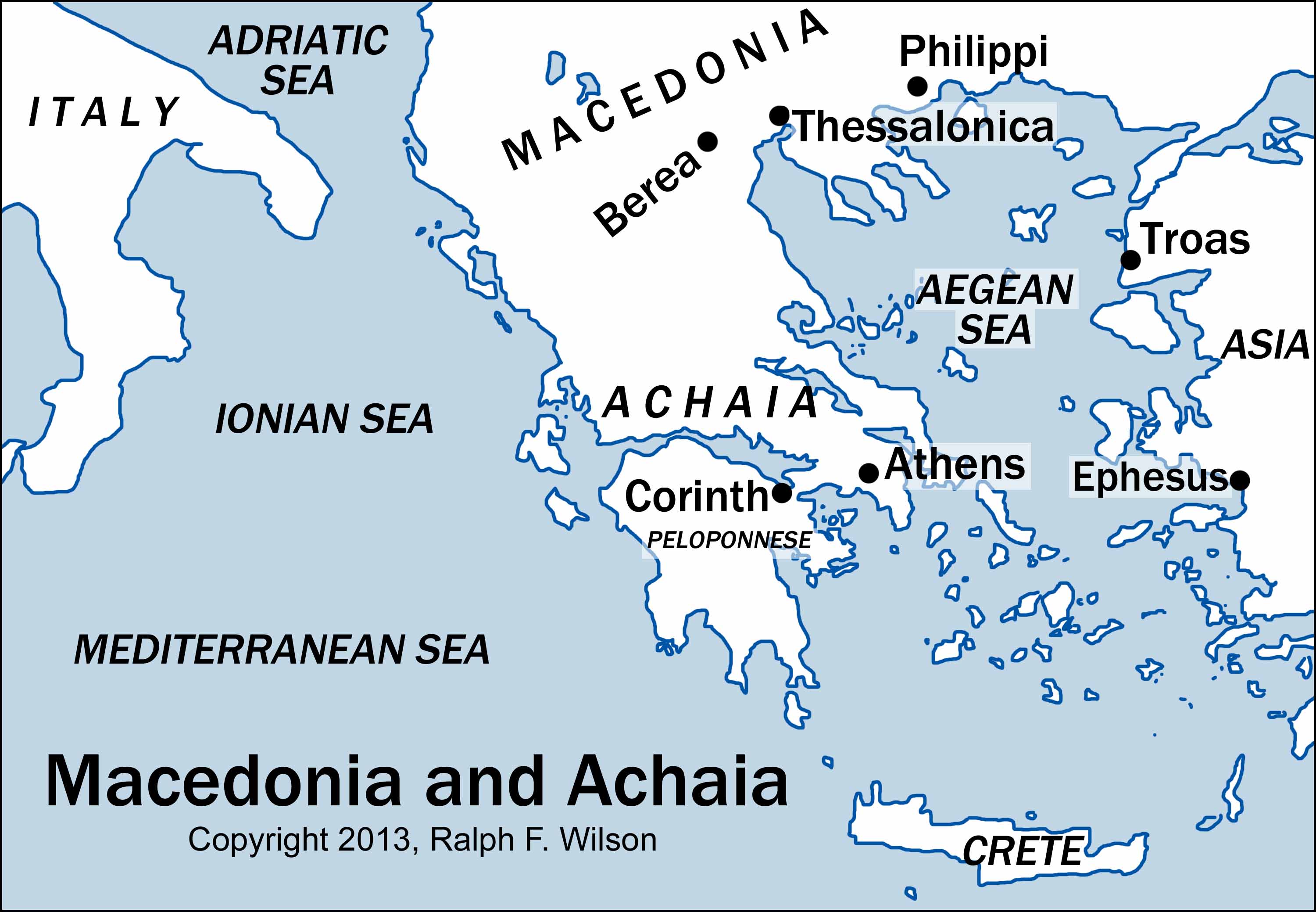
Thessalonica: Thessaloni'ca. (θεσσαλονίκη, in classical writers also θεσσαλονικεία and θετταλονίκη); In Paul's time, Thessalonica was a large and important town of Macedonia = a prominent seaport with commercial success, and the Capital of Macedonia with roughly 200,000 in population; visited by Paul on several occasions, and the seat of a Church to which two of his letters were addressed. This prosperous city was located on the Via Ignatia, the main road from Rome to the East, within sight of Mount Olympus, legendary home of the Greek pantheon.

Thessalonica location.
Mount Olympus location.
Mount Olympus, Greece.
Greek pantheon.

Thessalonica has a sizable Jewish population, and the ethical monotheism of Judaism attracted many Gentiles who has become disenchanted with Greek paganism.

Paul had many pleasant memories of the days he spent with the infant Thessalonian Church. Their faith, hope, love, and perseverance  in the face of persecution were exemplary (serving as a pattern, worthy of imitation).

Paul's labor as a spiritual parent to the fledgling church had been richly rewarded, and his affection is visible in every line of his letter to them.

Paul encourages them to excel in their new-found Faith, to increase in their love for one another, and to rejoice, pray, and give thanks always. He closes his letter with instruction regarding the return of the Lord, Whose advent signifies hope and comfort for Believers both living and dead.

Thessalonica survives today under the shortened name Salonika.

***************

1 Thessalonians ~ Chapter 1/Thursday Bible Study

Greetings & Thanksgiving

“From Paul, ^Silvanus, and ^^Timothy, to the Church of the Thessalonians, in Elohim the Father and the *Lord Yeshua Ha’Mashiach. Grace and peace be to you from Elohim and the Lord Yeshua Ha’Mashiach.

We thank **Elohim for all of you at all times and we make mention of you in our prayers. We cannot forget, as we appear before Elohim our Father, how your work came from your faith, how your toil came from your love, and your endurance came from your hope in the ***Lord Jesus Christ.

Brethren, we know that Elohim loves you and that He has chosen you. We brought the #Gospel to you, not in mere (this and that, and nothing more; simple, absolute, entire) words, but also with power – with the ****Ruach HaKo’desh and with full conviction (strong belief, state of being sensible), and you know how we conducted (personal behavior, management) ourselves among you for your sakes. And you, in turn, followed our example (a sample, pattern, model, precedent/going before, instance) and the example of the Lord. You not only accepted the Word, but you met persecution (unjust harassment, continued annoyance) in so doing, holding out in the Ruach HaKo’desh with much joy (pleasure, delight, expectation of good).

In that way, you became examples to all ^^^Believers throughout ##Macedonia and ###Greece, but not only that – the story of your faith has gone out in every direction so that people know, and we need not say another word. For people now tell us how we came to you, and how you left your idols and turned to *****Elohei Ha’Elohim and are now serving (to work for and obey) the true and living God. And they tell that you are now awaiting the return from Heaven of His Son, Yeshua, Whom Elohim raised from the dead, Who will deliver us from the coming wrath.” (vv. 1 thru 10)

^Silvanus = also, Silas: Paul’s companion on the second missionary journey, Silas was originally part of the early congregation at Jerusalem. He was one of the party bringing greetings and the decision of the Jerusalem Council to the Christians at Antioch. He returned to Jerusalem, then came back to Antioch in time to join Paul on the second journey. Like Paul, he was a roman citizen which, undoubtedly, saved his life during some of the troubles in the towns in Asia Minor and Macedonia. Silas stayed in Berea for a time, preaching, before joining Paul again in Corinth. Silas was with Paul when the letters were written from Corinth to Thessalonica. It seems, however, that Silas did not stay in Corinth during the year and half that Paul lived there. The next mention in the New Covenant of Silas is in the Book of 1 Peter – where he is described as the man carrying Peter’s letter from Rome to the churches in Asia Minor. Silas was probably associated with Peter after leaving Paul at Corinth. There was no hint of animosity however, between Silas and Paul. Acts 15 thru 18; 2 Corinthians 1:19; 1 Thessalonians 1:1; 2 Thessalonians 1:1; & 1 Peter 5:12

^^Timothy = son of the devout Jewish woman, Eunice, and a Greek father, Timothy became a follower of Yeshua Ha’Mashiach when Apostle Paul preached the Gospel in Lystra, Timothy’s hometown. Paul invited the young convert to accompany him on his second missionary journey; and was sent to Thessalonica to strengthen the fellowship there. After another journey with Paul, Timothy was sent to Corinth to straighten out some problems upsetting the fellowship there.

Timothy later looked after Paul during Paul’s imprisonment. Timothy subsequently was asked to go to Ephesus to represent Paul, and received the two letters from Paul that bear Timothy’s Name. Timothy – these letters reveal, was like a son to Paul. The last word in the New Covenant

About this sensitive, sickly, but faithful young helper was that he was imprisoned but finally released. Acts 16:1, 17:14-15, 18:5, 19:22 & 20:4; Romans 16:21; 1 Corinthians 4;17 & 16:10; 2 Corinthians1:1 & 19; Colossians 1:1; 1 Thessalonians 1:1, 3:2, & 6; 2 Thessalonians 1:1; 1 & 2 Timothy; Philemon 1; and Hebrews 13:23.

^^^Believers: worshiper; worshippers.

*Yeshua Ha’Mashiach: is Hebrew for “Jesus the Messiah”; the name Jesus is the Greek form of the Hebrew name Yeshua.

**Elohim (Hebrew: אֱלֹהִים, Romanized: Elohim: [(eloˈ(h)im]) is a Hebrew word meaning "Gods – Father, Son, & Holy Spirit". Although the word is plural in form, in the Hebrew Bible it usually refers to a single deity “Behold, the Lord – the Lord is One”, particularly the God of Israel.

***Lord Jesus Christ (in Greek: Kyrios Iēsous Christos) = the most formal title for Jesus (Yeshua). It occurs often in the New Testament letters.

The word “Lord” has a wide range of uses; it can be a simple respectful “Sir” or a more formal, “Master.” But the New Testament also uses “Lord” of God. The word “Christ” is the anglicized form of the Greek word meaning “anointed one” or “Messiah.” “Lord Jesus Christ” reminds us that Jesus is both the promised Messiah and our God.

Christ (from the Hebrew word, Ha’Mashiach ישוע המשיח & the Greek word, Christos/khris-tos) = The Anointed, Yeshua the Messiah, in both languages.

****Ruach HaKo’desh: In Hebrew, the Holy Spirit (רוח הקודש, Roo-ahk hah-Koh-desh) refers to the divine force, quality, and influence (aka, power) of God.

The Holy Spirit (Luke 3:16 & 11:13; 1 Corinthians 6:9; Ephesians 1:13 & 4:30; 1 Thessalonians 4:8; Titus 3:5; and Jude 1:20), is referred to more than 90 times in the Brit Chadashah.

*****Elohei Ha’Elohim (Hebrew word: אֱלֹהֵי הָאֱלֹהִים) = God of gods; above all gods.

#Gospel = teaching or revelation of Christ.

##Macedonia: Macedonia has a long, rich history dating back to biblical times. In fact, Macedonia is mentioned at least 23 times in seven books of the Holy Bible. The Macedonian region, located in south-central Balkans, is comprised of northern Greece, southwestern Bulgaria, and the independent Republic of North Macedonia.

###Greece: What was Greece called in biblical times? Also serving as the Hebrew name for Greece or Greeks in general, יָוָן Yavan or Yāwān has long been considered cognate with the name of the eastern Greeks, the Ionians (Greek Ἴωνες Iōnes, Homeric Greek Ἰάονες Iáones; Mycenaean Greek *Ιαϝονες Iawones).


**Colossians 3 & 4: https://jeastofeden.blogspot.com/2023/01/colossians-chapters-3-bible-study.html

Thursday, January 12, 2023

Colossians ~Chapters 3 &4/Thursday Bible Study

Chapter 3 of Colossians links the three themes of the epistle together, showing their cause-and-effect relationships. Because the Believer is risen with *Christ, he/she is to put off “the old man” (self = ego), and put on the New, which will result in holiness in all relationships.

I’m still working on putting off the ‘old me’ … just like you are; we are all a work in progress. Yet, Elohim remains faithful to bring our spiritual metamorphosis to completion 😉

**********

Colossians ~ Chapter 3/Thursday Bible Study

The Life Hidden in Christ

“If you have been raised with Christ, seek the things that are above, where Christ is seated at the right hand of Elohei Ha’Elohim. Keep thinking about the things above, and not of the things here on Earth. For you have died, so to speak, and your new life is hidden with Christ in God. Christ is the secret of our spiritual life and, when He returns, you also will appear with Him in glory. (vv. 1 – 4)

The “Old Man” Put Off

You must put to death your lower, earthly nature – fornication, impurity, passion, and greed – which are a form of idolatry. All these are sins that bring God’s wrath down on those who disobey. You, too, at one time used to live in these sins, and were counted among the sons of disobedience. You must also out off these things: anger, rage, spite, slander, and foul talk. And do not lie to one another. Stop those practices, seeing that you have put off the “old man!” (vv. 5 – 9)

The “New Man’ Put On

And now you have put on the “new man!” And he is being renewed from day to day in knowledge and in the likeness of the creator. Here there is neither Greek nor Jew, neither circumcision nor uncircumcision. No one is a ***Barbarian or a ****Scythian, no one is a slave or a free man. Christ is all – and in all.

You are God’s chosen ones, holy and beloved. Therefore, adorn yourselves with compassion, kindness, humility, gentleness, and patience. Also, you must be tolerant with one another and be willing to forgive if one should have a complaint against another. Just as the Lord forgave you, so you, too, must forgive. And on top of all these place love – which binds you together in perfect harmony. Let the peace of God rule in your hearts so you can be one Body, as was Elohim’s purpose in His call to you. And do be thankful!

Let the Word of God dwell in you in all its richness. Teach and admonish one another in wisdom and psalms (holy prayer songs, poems), and hymns and spiritual songs. Sing to God with grace in your hearts. And whatever you do, in word or in deed, do everything in the Name of the Lord Jesus and give thanks to God the Father in His Name. (vv. 10 – 17)

Duties of Members of the Family

Wives, be subject to your husbands, as is fitting in the Lord. Husbands, love your wives, and do not be harsh with them. Children, obey your parents in everything, for this is well-pleasing to the Lord. Fathers, do not provoke your children to resentment; lest they become disheartened (sad, spiritually broken). (vv. 18 – 21)

Duties to Servants

Servants, obey your earthly masters in everything, not as though they were watching you or because you were trying to please them, but rather because your heart is sincere and because you fear the Lord. So, no matter what the task. Do your work heartily, as though doing it for the Lord and not for men. And you may be sure that you will receive from the Lord the inheritance as your pay … for you are the servants of the Lord Christ. But the wrongdoer will get punishment for his wrongdoing, without any respect of persons, master or man.” (vv. 22 – 25)


*Christ (from the Hebrew word, Ha’Mashiach ישוע המשיח & the Greek word, Christos/khris-tos) = The Anointed, Yeshua the Messiah, in both languages.

Yeshua Ha’Mashiach: is Hebrew for “Jesus the Messiah”; the name Jesus is the Greek form of the Hebrew name Yeshua.

**Elohei Ha’Elohim (Hebrew word: אֱלֹהֵי הָאֱלֹהִים) = God of gods; above all gods.

***Barbarian = Paul uses the word in its Hellenic sense to refer to non-Greeks (Romans 1:14); and he also uses it to characterize one who merely speaks a different language (1 Corinthians 14:11).

****Scythian = these people consisted of “all the pastoral tribes who dwelt to the north of the Black Sea and the Caspian, and were scattered far away toward the east”: modern day Russia.


**Colossians 2: 

https://jeastofeden.blogspot.com/2022/12/colossians-chapter-2thursday-bible-study.html

***************

Colossians ~Chapter 4/Thursday Bible Study

Colossians is perhaps the most Christ-centered Book in the Bible, as Paul stresses the superiority of the person of *Yeshua Ha’Mashiach, and the completeness of the Salvation Plan in Him, ONLY.

The last half of this epistle explores the application of holy principles to daily life, because doctrinal Truth (chapters 1 & 2) must bear fruit in practical conduct (chapters 3 & 4).

The two major topics of the Book of Colossians are: the supremacy of Christ (chapters 1 & 2) and submission to Christ (chapters 3 & 4).

In this final chapter, Paul outlines the transformation that faith in Christ should make in relationships inside – and outside – the home.

Before anyone gets on their high-horse and starts screaming about “master and slaves” comments, let me just state that slavery was a huge part of the ancient world – slavery still goes on in Islamic countries. Also, masters can be referenced as employers or civic leaders/president and DC cronies, and slaves as employees or populace at large when tyranny rules. THINK before screaming “foul!”

This is the last chapter of this Book. Next study, we will begin with the 1st Book of Thessalonians.

**********

Colossians ~ Chapter 4/Thursday Bible Study

Duties of Masters

“Masters, treat your servants justly and fairly, remembering that you, too, have a Master in Heaven. (v. 1)

Exhortation to Prayer & Christian Walk

Cultivate the habit of praying. Be watchful (alert, attentive) in it, and give thanks. And by all means, pray also for us, that **Elohim may open to us a door for the Word, so that we may reveal the secret of Christ, on account of which I am now in prison. I want to make this mystery plain to men, and it is my duty to do so. Conduct yourselves wisely towards non-Christians, and make good use of your time. Be gracious in your speech. Let it be, so to say, seasoned with salt (so that you may know how you ought to answer each person = salt is used as a seasoning to give flavor, and as a preservative to prevent decay/rot). Study to answer each one in a proper way. (vv. 2 – 6)

Commendation of Workers

***Tychicus will tell you about my circumstances. He is a beloved brother, a faithful minister and a fellow servant in the Lord. I am sending him to you for this very purpose, that you may know how we are; and also, that he may give your hearts renewed courage. With him I am sending ****Onesimus, also a faithful and beloved brother, who is one of your own. These two will infirm you about everything that has happened here. #Aristarchus, my fellow-prisoner, sends greetings to you. So also does ##Mark, a cousin of ###Barnabas. You have already received instructions that, if he comes to you, you must welcome him. Also ####Justus, greets you. Of the Jewish Christians, these three are the only ones working with me for the kingdom of God, and they have been a great help to me.

!*Epaphras sends his greetings. He is one of you, and a servant of Yeshua Ha’Mashiach. He never forgets to pray for you, earnestly beseeching that you may hold out and perfectly carry out Elohim’s Will in everything. I can testify to this – that he has worked hard for you, as well as for those in Laodicea and in Hierapolis.

Also !!*Luke, the beloved physician, and !!!*Demas want to be remembered to you. (vv. 7 – 14)

Conclusion

Give my greetings to the brethren in Laodicea, and to !!!!*Nymphas, and to the church at his house.

When his letter has been read among you, see to it that it is alaso read in the church at Laodicea. And please say to !!!!!*Archippus, “God called you into His service – Oh, do not fail Him!”

I, Paul, write this farewell greeting with my own hand. Remember me, for I am a prisoner. Grace be with you! Amen.” (vv. 15 – 18)


*Yeshua Ha’Mashiach: is Hebrew for “Jesus the Messiah”; the name Jesus is the Greek form of the Hebrew name Yeshua.

Christ (from the Hebrew word, Ha’Mashiach ישוע המשיח & the Greek word, Christos/khris-tos) = The Anointed, Yeshua the Messiah, in both languages.

**Elohim (Hebrew: אֱלֹהִים, romanized: ʾĚlōhīm: [(eloˈ(h)im]) is a Hebrew word meaning "Gods – Father, Son, & Holy Spirit". Although the word is plural in form, in the Hebrew Bible it usually refers to a single deity “Behold, the Lord – the Lord is One”, particularly the God of Israel.

***Tychicus = a Gentile convert from Ephesus, Tychicus was selected with Trophimus to take the offering from the Ephesian congregation and join Paul’s missionary group journeying to Jerusalem. After Paul’s arrest, imprisonment, and trip to Rome, Tychicus was a useful messenger and representative for Paul to various churches. He carried Paul’s letters to the Ephesians and the Colossians, and possibly the second letter to the Corinthians. Whether Tychicus got to Crete, as Paul hoped, we do not know. Legend has it that Tychicus became Bishop of Chalcedon in Asia Minor, and died a martyr. Acts 20:4; Ephesians 6:21; Colossians 4:7; 2 Timothy 4:12; & Titus 3:12

****Onesimus = the runaway slave belonging to Philemon who became a Christian under Paul. Onesimus had stolen some of his master’s money and left; he encountered Paul, probably at Rome, and ministered to Paul as a servant. Although Paul would have liked to have kept Onesimus, he was returned to his master Philemon, at Colossae, probably in the company of Tychicus. Onesimus was commended to Philemon and the other Christians as a Christian brother; tradition has it that Onesimus became a trusted and respected leader in the church. Colossians 4:9 & Philemon 10

#Aristarchus = a loyal co-worker of the Apostle Paul, Aristarchus hailed from Thessalonica, but was in Ephesus and arrested with Gaius during the riot that followed Paul’s first appearance in that city. Aristarchus was Paul’s constant companion at the close of the apostle’s life – journeying with him from Troas to Jerusalem, and from Jerusalem to Rome; and sharing Paul’s imprisonment in Rome. According to tradition, Aristarchus also died a martyr’s death in Rome – during Nero’s persecutions. Acts 19:29, 20:4, & 27:2; Colossians 4:10; & Philemon 24

##Mark: Author of the 2nd Gospel, Mark was a companion of both Paul and Peter. “John” was his Jewish Name – “Mark”, a Latin or Greek name. His mother, Mary, was a woman of means and influence in Jerusalem, and her house was a meeting place for the earliest followers of Yeshua, following His resurrection. Mark was part of the Christian Community from the first. All ancient traditions agree that Mark dies a martyr. Acts 12:12, 25 & 15:37-39; Colossians 4:10; 2 Timothy 4:11; & Philemon 24

###Barnabas: friend and companion of Apostle Paul, Barnabas was named Joseph, and was a Levite whose home was in Cyprus. Highly respected by Christians leaders in the early church, Barnabas was instrumental in bringing the newly converted Saul (aka Paul) from Tarsus to Antioch – and influential in having Saul received by the Apostles in Jerusalem. Later, the two were commissioned by the church at Antioch to conduct a missionary tour: their friendship continued, and Paul speaks warmly of Barnabas in his letters. There are no accounts of Barnabas’s later life, or death. Acts 4, 9, 11-15; 1 Corinthians 9:6; Galatians 2; & Colossians 4:10

####Justus = a convert to Judaism in Corinth, this Justus was known as Titius Justus or Titus Justus; he lived next door to the Corinth synagogue. His name implies that he was a Roman citizen, or a person of Latin background – not a Jew. Apostle Paul made his home with Justus for some time in Corinth … obviously Justus became a Christian Believer at some point during his friendship with Paul. Acts 18:7

!*Epaphras: One of Apostle Paul’s friends and co-workers, Epaphras was from Colossae, and founded the church in his home town. He was looked up to as a leader in the Church of Asia, and came to visit Paul in prison in Rome. Seized by the Romans, he was thrown into prison with Paul. Some of Paul’s deepest tributes are applied to Epaphras: “fellow prisoner”, and “faithful minister.” Colossians 1:7; 4:12; & Philemon 23

!!*Luke: Co-worker with Apostle Paul, and author of the 3rd Gospel, as well as the Acts of The Apostles. He was an educated non-Jew, who was converted to Jesus Christ without first becoming a Jew. Some think he may have come from Philippi – others, from Antioch or Syria. Luke joined Paul at Troas on the Apostle’s second missionary journey, and went to Philippi with him. Six years later he accompanied Paul on his 3rd missionary journey; which ended up in Jerusalem. Luke faithfully stayed with Paul until the very end of the Apostle’s final imprisonment in Rome. Luke; The Acts; Colossians 4:14; 2 Timothy 4:11; Philemon 24

!!!*Demas = one of Paul’s co-workers and esteemed friend for a time, Demas shared in Paul’s hardships during the first part of his prison term in Rome. Demas even joined Paul in sending personal greetings to the Christians at Colosse and to Philemon’s family, but … later, “in love with the present world” Demas forsook Paul and Christianity (2 Timothy 4;10); there is no tradition that he ever returned to the Faith. Colossians 4;14; Philemon 24; 2 Timothy 4:10

!!!!*Nymphas = a woman in the little congregation at Laodicea. Nymphas was apparently a woman of prominence and means in the community, inasmuch as her house was the meeting place for the church at Laodicea. Possibly Paul mentioned her by name because he knew his letter would be read in her house. Colossians 4:15

!!!!!*Archippus = a beloved co-worker of Paul, Archippus was probably the son of Philemon and Apphia – or their close relative. Besides being asked to shelter the escaped slave, Onesimus, Archippus was encouraged by Paul in the letter to the Colossians, to be faithful in his duties, hinting that he was an officer or leader in the church at Colossae. Colossians 4:17 & Philemon 2